

Support for Osaka Prefecture's Carbon-Neutral Technology Development and Implementation Project
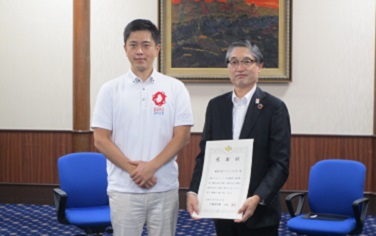
MUFG donated 500 million yen to support the growth of Osaka Prefecture's energy business and to help the prefecture achieve its goal of carbon neutrality by 2050. Osaka prefecture has formulated a 10-year action plan to combat global warming from FY 2021 to 2030, with the goal of reducing greenhouse gas emissions in the prefecture by 40% by FY 2030 compared to levels in FY 2013.
Additionally, at the Expo 2025 Osaka Kansai, MUFG showcased and promoted cutting-edge technologies aimed at realizing a carbon-neutral society to visitors from around the world.
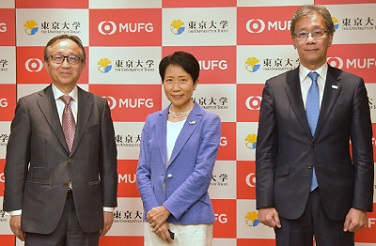
Partnership of Industry and Academia with the University of Tokyo
Support for Hydrogen Fueled Bus
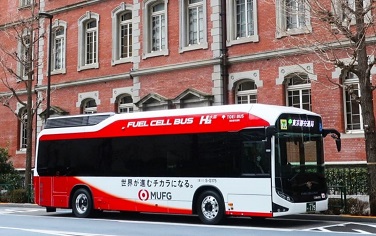
Various initiatives are currently underway to realize a hydrogen energy-based society in Japan. Among them, the introduction of fuel cell buses (hydrogen buses) as commercial vehicles is attracting attention because it is expected to create stable hydrogen demand while contributing to decarbonization.
Against this backdrop, MUFG has made donations to the Tokyo Metropolitan Bureau of Transportation, Osaka City Bus, Nankai Bus, and the City of Nagoya to support their promotion and introduction of fuel cell buses (hydrogen buses). In FY 2023, we provided support for the introduction of hydrogen buses at Centrair (Chubu Centrair International Airport).
MUFG Forest for Working Together with Customers
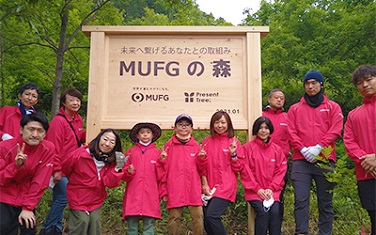
MUFG is undertaking the MUFG Forest Project, which involves planting about 100,000 trees and donating a total of 500 million yen over 10 years to fund their cultivation. Planting 100,000 trees absorbs CO2 that is equivalent to the annual CO2 emissions from the electricity used to cool 10,000 households. MUFG plants trees through the Present Tree (note 1) project based on the number of bankbooks, documents, and usage statements issued by its group companies that have been switched from paper-based to online, as well as the number of new applications for online services. As of March 2024, we have achieved our goal and successfully planted 100,000 trees.
(note 1) The Present Tree project was initiated in January 2005 by Environmental Relations, a certified NPO. Through this project, participants plant trees in honor of loved ones or for themselves to help reforest and revitalize local communities. MUFG is planting trees in places where forests should be created, such as forests damaged in natural disasters, former development sites, and abandoned clear-cutting sites in various parts of Japan, where the birthrate is declining, and the population is aging.
Support for Cyclic Utilization of Forests
In recent years, the abandonment of artificial forests planted for timber production has become a serious social issue. In light of this, MUFG made donations to the Lifestyle Research Institute of Forests, which is engaged in forest conservation activities as part of our efforts to promote the cyclic utilization of forest resources. This is a process in which trees are planted, grown, harvested, used, and planted again. Approximately 3,000 employees participated in volunteer activities to create educational puzzles using thinned wood. The finished puzzles were donated to kindergartens and other children's facilities.
MUFG, in collaboration with the organization, has also started planting forests in Nose, Osaka, planting sawtooth oak trees and trees of chestnuts. Oak trees are used as materials for sawtooth oak charcoal, a traditional industry in the region and trees of chestnuts are a specialty product there.
To leave bountiful forests for the next generation, we will continue to support forest conservation activities, including tree planting, thinning, and the use of thinned wood.
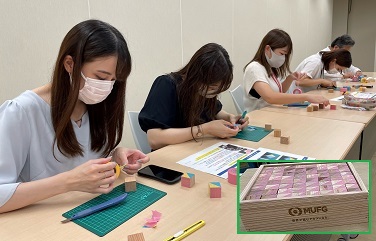
Employees making puzzles from thinned wood
Marine Environmental Conservation Activities
Pollution of oceans and coasts is becoming more serious, and the problem of plastic in the ocean has gained worldwide attention.
As part of our efforts to protect the richness of the ocean, MUFG has been organizing Beach Cleanup Events to pick up garbage, including problematic plastic waste, in Kanagawa, Aichi, and Hyogo prefectures. In FY 2024, approximately 280 MUFG employees and their families participated in coastal cleanup activities and marine education events together with local environmental protection organizations, which provided an excellent opportunity to reflect on the issue of garbage in the oceans.
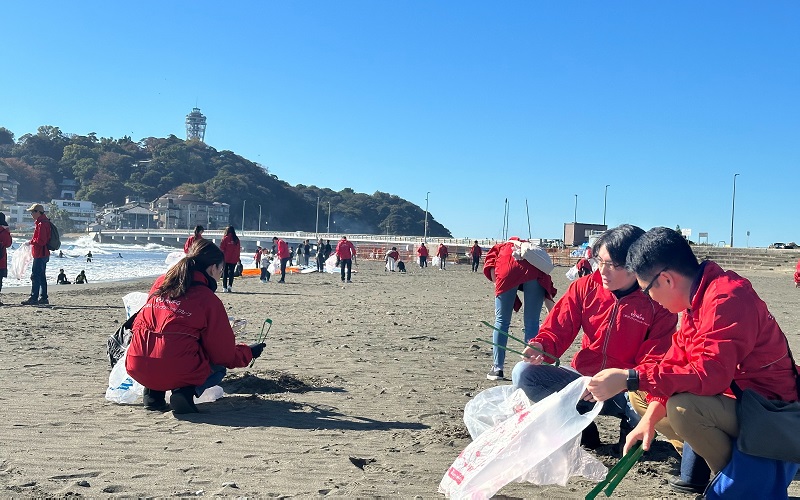
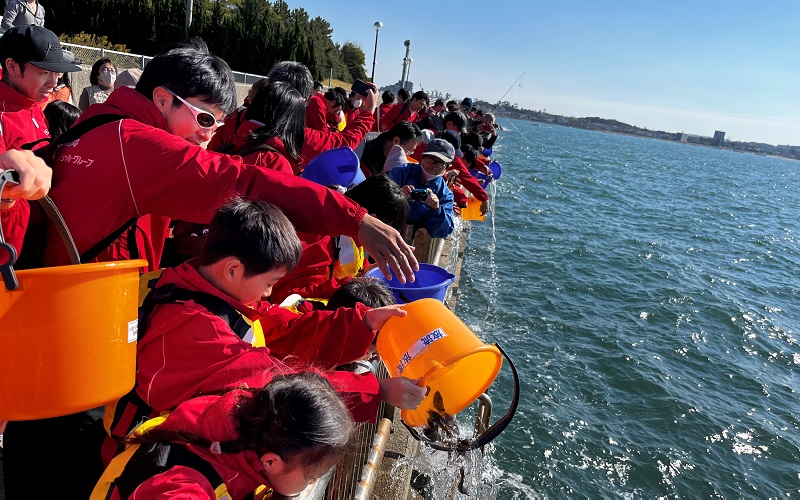
release of juvenile fish at Shinmaiko Beach in Aichi Prefecture
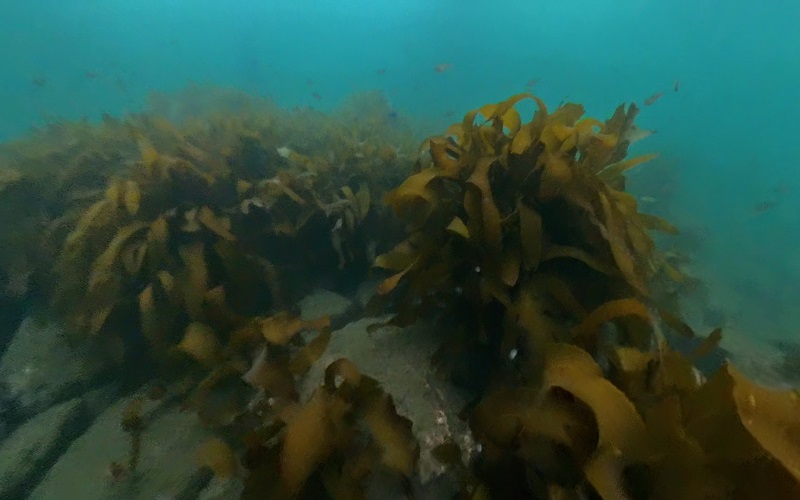
Support for Seagrass Bed Restoration Project
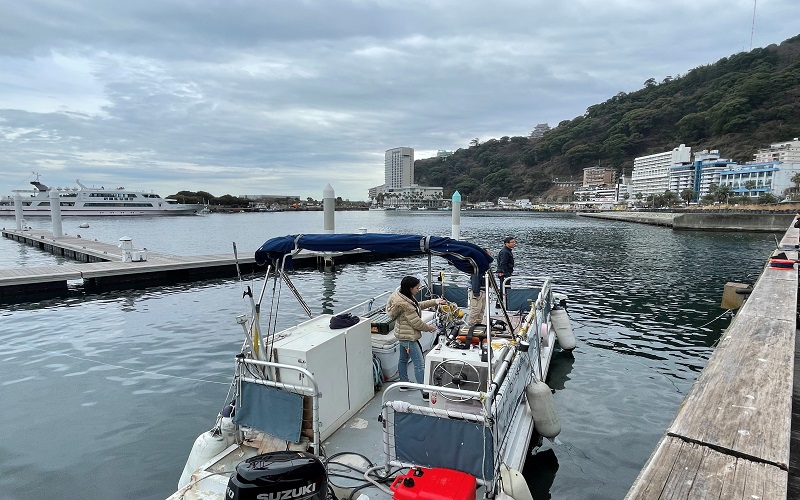
Support for Conservation of Biodiversity
Zoos and aquariums play a crucial role in the preservation of species and the natural environment through species conservation activities, ecological research, and environmental education. MUFG has donated to the Japanese Association of Zoos and Aquariums (JAZA) and established the MUFG Biodiversity Conservation Research Support Fund (totaling 50 million yen).
This fund supports research that contributes to the conservation of rare species and biodiversity around the world, as well as activities that contribute to social education. MUFG aims to convey the importance of conserving biodiversity to visitors of zoos and aquariums as well as to the general public by supporting these facilities and collaborating with them to promote their initiatives.
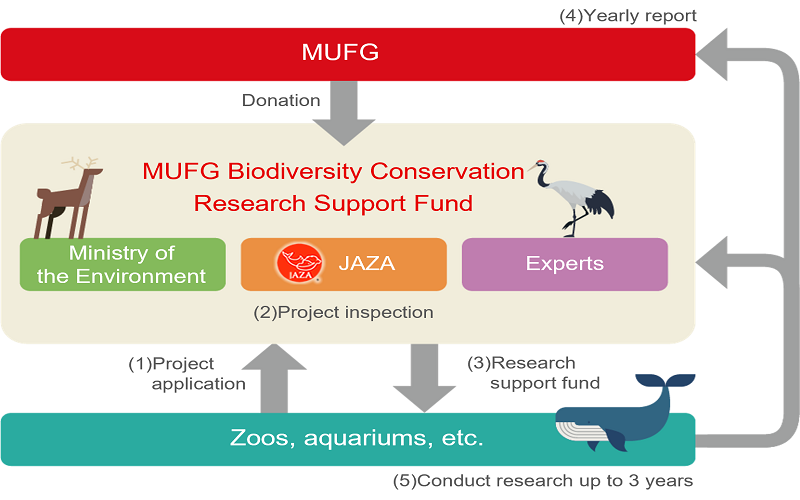
The mechanism of the MUFG Biodiversity Conservation Research Support Fund