
[ Main contents start here ]

Governance

  1. Only the Sustainability Governance section is available on this page; all other content will be redirected to separate pages.

Sustainability Governance

For more information on MUFG's corporate governance, please refer to the below.

Sustainability Governance Structure

Sustainability-related issues are managed by the Executive Committee with various management sub-committees, subject to the oversight of the Board of Directors. The Sustainability Committee, which is a sub-committee formed under the Executive Committee and is chaired by the Chief Sustainability Officer, regularly deliberates policies on addressing sustainability-related matters, including risks and opportunities arising from such matters, and monitors the progress on the MUFG Group’s measures designed to address such matters. The committee reports to the Executive Committee and, as necessary, reports to the Board of Directors.

The Executive Committee is established as a decision-making body for business execution and discusses and decides on important matters related to management of the operations of the MUFG Group based on the basic policies determined by the Board of Directors. The Executive Committee reports to the Board of Directors from time to time as necessary.

The Board of Directors oversees management of sustainability-related matters in line with its business strategy, risk management and financial oversight. Such oversight is performed based on, among other things, a plan-do-check-act, or PDCA, cycle. The Board of Directors deems sustainability-related matters including climate change to be of high-priority importance and accordingly discusses and deliberates them regularly based on an annual schedule or as appropriate.

In addition, four external advisors have been invited to provide expert opinions on sustainability issues and risks at any time. These advisors exchange opinions with the members of the top managements and others and provide advice and recommendations from their professional standpoints on MUFG's sustainability initiatives.
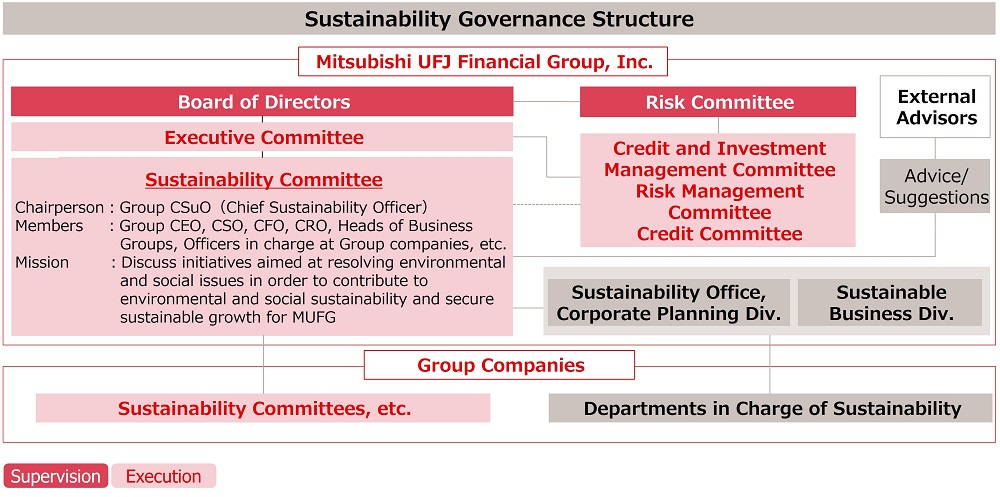
Sustainability Governance Structure

Roles of Each Position and Department

Group Chief Sustainability Officer (CSuO)

The Group Chief Sustainability Officer is responsible for all initiatives to promote sustainability management. The CSuO promotes sustainability initiatives in line with management strategies under the leadership of the Group CSO (Chief Strategy Officer), who is responsible for corporate planning and strategy.

External advisor

The external advisor regularly exchanges views with the management in order to make use of external knowledge for sustainability management.

Sustainability Office, Corporate Planning Division

The Sustainability Office is responsible for developing the foundation of MUFG's sustainability management as well as planning and promoting strategies for solving environmental and social issues while achieving sustainable growth.

Sustainable Business Division

An organization dedicated to promoting sustainable business. By integrating MUFG's expertise in sustainability both in Japan and overseas, the Division supports the sustainable growth of customers by providing various types of information and solutions from the standpoint of solving environmental and social issues.

Sustainability Risk Management Office, Credit Policy & Planning Division

The Sustainability Risk Management Office is responsible for planning MUFG's sustainability risk management, including the assessment and management of climate-related risks and the development and enhancement of related methodologies.

Sustainability Committee

MUFG holds Sustainability Committee in principle at least once a year to identify ESG issues affecting corporate management, and report and discuss how the Group is responding to them.

External Advisors in the Environment and Social Fields

Since 2019, we have engaged external experts in the environmental and social fields as permanent external advisors. Opinions were exchanged between the experts and the members of the Board of Directors, allowing us to use their broad knowledge of ESG in our sustainability initiatives.
Rintaro Tamaki President, Japan Center for International Finance
Junko Edahiro Professor, Graduate School of Leadership and Innovation, Shizenkan University / President, Institute for Studies in Happiness, Economy and Society / Founder and President, e's Inc.
Kenji Fuma CEO, Neural Inc.
Miyuki Zeniya evergreenp

Study Sessions for Management

In order to invigorate internal discussions on sustainability, MUFG group companies invited experts in various fields to hold study sessions. In study sessions, the management team actively exchanges opinions with these experts.

Executive Compensations

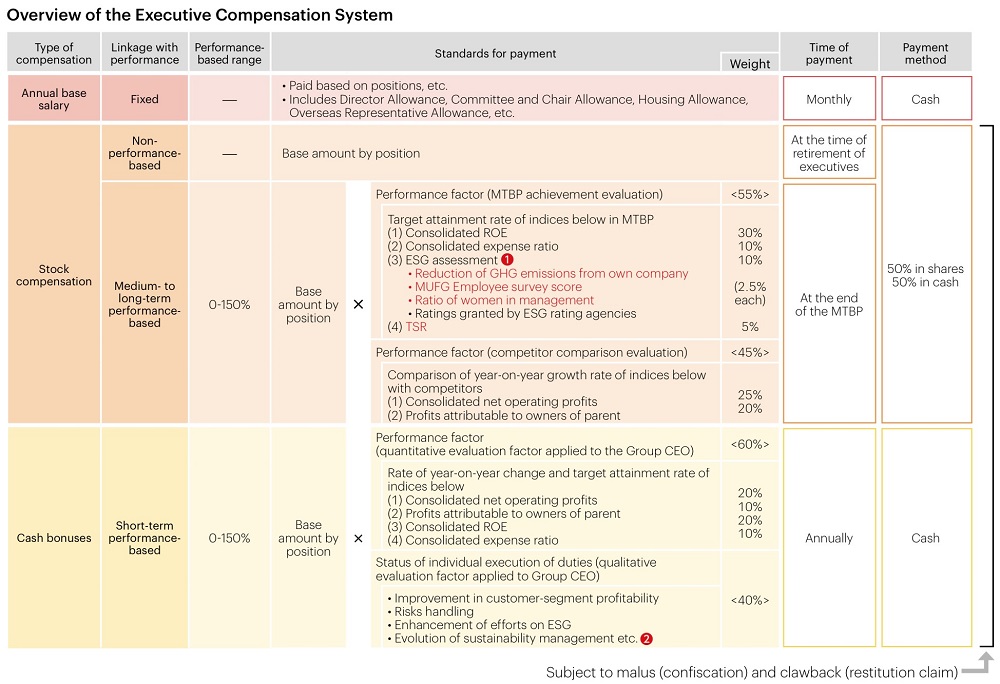
MUFG has incorporated ESG elements into its executive compensation system to achieve the medium-term business plan and execute sustainability management.

Starting in fiscal 2024, we have increased the evaluation weight for the medium- to long-term performance-based portion of stock compensation and adopted new own three indicators in addition to the existing one for the ratings granted by ESG rating agencies.

Additionally, for the qualitative evaluation method for bonuses to be paid to the Group CEO and other relevant officers, we have established approximately five evaluation items, such as improvement in customer-segment profitability, promoting structural reforms and strengthening the management foundation, risks handling, enhancement of efforts on ESG and evolution of sustainability management. Each item is evaluated based on its respective KPIs (key performance indicators), and the overall qualitative evaluation is conducted on an eight-point scale. Furthermore, ESG elements have also been incorporated into the bonus evaluations of each executive officer in accordance with the business strategies for the business they are responsible for.

Executive Compensations
  1. MUFG has set the reduction of Group/Global GHG emissions from own operations, improvement of the employee survey scores, and raising of the ratio of women in management as unique ESG self-assessment metrics, to support the further enhancement of sustainability management. Additionally, to assess the extensive initiatives toward ESG of MUFG from an objective standpoint, a relative evaluation is carried out on the degree of improvement (3-year) of third-party assessments by the five major ESG assessment agencies (MSCI, FTSE Russell, Sustainalytics, S&P Dow Jones and CDP).
  2. ESG-related evaluation items subject to qualitative evaluation include contribution to the resolution of environmental and social issues through the promotion of DEI, the strengthening and upgrading of MUFG’s governance structure, and evolution of initiatives to promote natural capital, a circular economy, and human rights.

(Malus・Clawback)

  • In regards to stock compensation and cash bonuses of Officers etc., the unpaid portion may be forfeited (malus) or repayment of the amount that has already been paid may be demanded (clawback), in the event that a serious violation has been committed regarding the delegation agreement, etc. between MUFG and Officers, etc. in relation to the duties of Officers, etc., a person resigns during his or her term of office due to personal circumstances against the wishes of MUFG, and situations such as when modifications to the financial statements after-the-fact due to significant accounting error or fraud are resolved by the Board of Directors.
  • For the remuneration of certain high earners other than executives, it is stipulated that in cases of significant amendments to the financial statements, serious violations, etc. of applicable laws, and the company's regulations, the remuneration may be subject to reduction, suspension, forfeiture, cancellation, offset with other remuneration, or return after payment. Furthermore, the variable remuneration for these high earners, in principle, is operated within a range of 0% to 200% of the base amount of performance-linked compensation.
(As of April 2026)