

Empowering Japan’s Space Industry: How MUFG’s Financial Strength Is Shaping a More Sustainable Tomorrow
MAR. 26, 2025
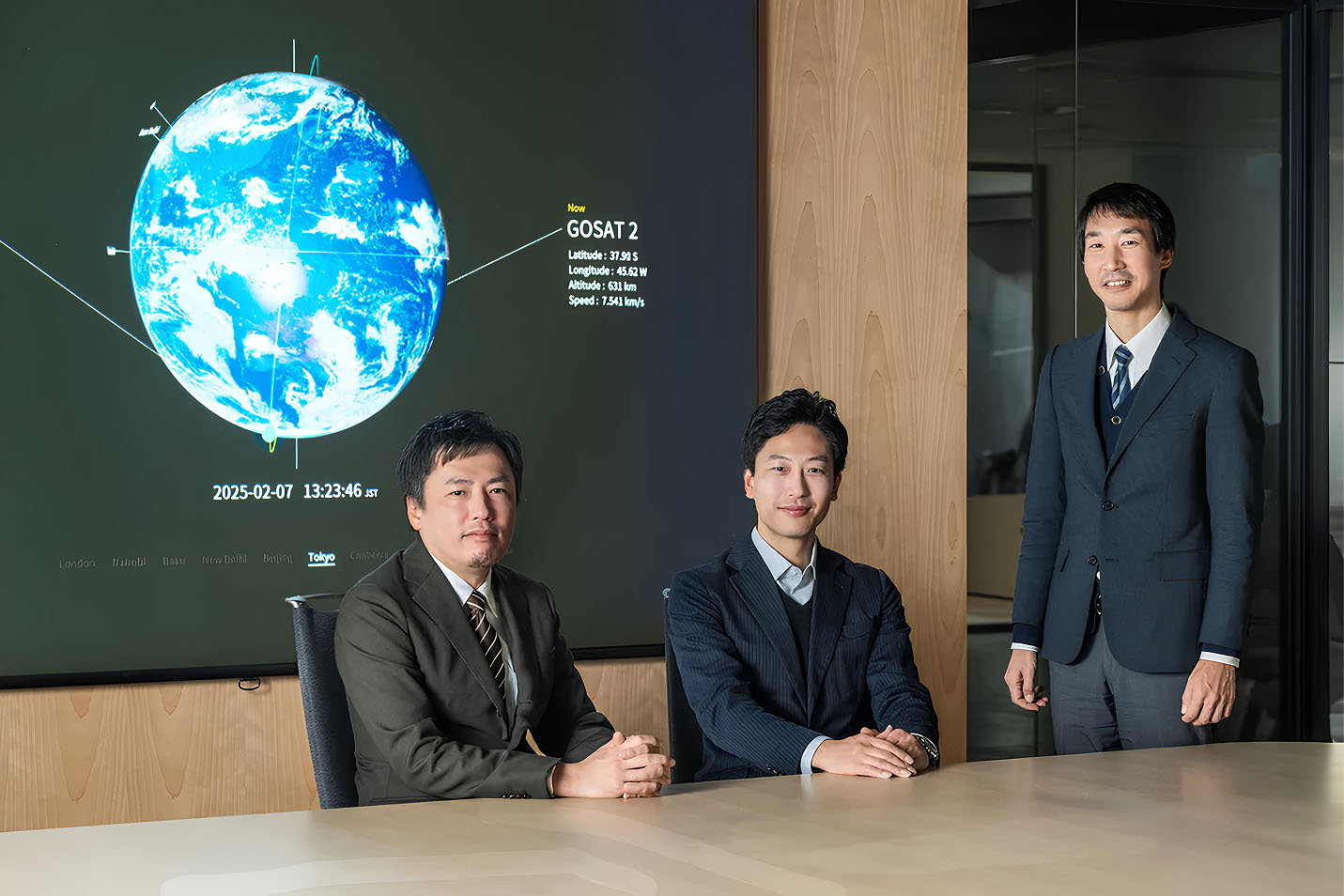
Throughout history, humanity has created and reshaped economic spheres by fostering new industries through collaboration among diverse players. Today, that frontier is expanding into space.
In this three-part series, we explore how MUFG (Mitsubishi UFJ Financial Group)—an institution that has long supported groundbreaking innovation and played a key role in the birth of new industries—is now taking on the challenge of shaping a new ecosystem born from the space economy. Rather than focusing solely on businesses using space technologies, MUFG approaches the future of industry creation from a broader, financial perspective—revealing insights only visible from such a vantage point.
In the first installment, we examine how satellite-based greenhouse gas monitoring contributes to global sustainability, and explore the new forms of value and economic ecosystems emerging as a result.
According to research by the Cabinet Office, the global space industry is valued at approximately US$680 billion, with projections estimating growth to US$1.01 trillion by 2030 and US$1.71 trillion by 2040 (based on exchange rates as of early 2024). A significant portion of this growth is expected to come from businesses that utilize satellite-derived data on Earth.
When most people hear “space industry,” they tend to picture dramatic rocket launches soaring into the sky. But the real value lies not in the spectacle of launch, but in the data that satellites deliver once in orbit. That data—capturing everything from environmental changes to infrastructure conditions—can be leveraged on the ground to support smarter decision-making, reduce costs, and drive innovation across sectors, all without requiring substantial capital investment from end users. By enabling faster, more precise responses to societal and environmental challenges, satellite data has the potential to generate not only economic returns, but also a long-term social and ecological impact.
Positioned at the intersection of finance and innovation, MUFG is taking a forward-looking approach to industry creation—mobilizing both financial and non-financial resources to unlock new value within the evolving space economy.
A Mission to Support and Shape Industry from Its Infancy
Takumi Hashizume, Head of the Space Innovation Office within MUFG’s Sustainable Business Division, reflects on the group’s broader mission.
“MUFG is committed not only to financing Japan’s space industry, but also to shaping the value chains that will support its long-term growth. This includes bridging supply and demand to help integrate so-called ‘non-space’ companies—those whose core business lies outside the space sector—into the emerging space economy. Through both financial and non-financial initiatives, our goal is to cultivate an ecosystem of innovation and value creation, with Japan’s space industry at its core,” he says.
Why is MUFG—a financial institution—so deeply invested in the future of space?
“To answer that, we need to revisit the fundamental role of a bank,” Hashizume explains. “Article 1 of Japan’s Banking Act states that banks exist to contribute to the sound development of the national economy. Throughout our history, MUFG has played a role in nurturing key industries from their inception—including Japan’s automotive sector, among many others. Today, the country’s space industry stands at a similar turning point.”
Hashizume continues: “In many ways, the rise of the space industry represents an effort to integrate the outputs of countless industrial achievements under one expansive domain—space. It is, in essence, a culmination of Japan’s strengths: automotive engineering, consumer electronics, semiconductors, and precision components. For MUFG, this marks a pivotal moment to consolidate the knowledge, networks, and co-creation experience we have built over decades—and apply them to accelerate the next wave of industrial transformation.”

Takumi Hashizume | Head of the Space Innovation Office within MUFG’s Sustainable Business Division
Advancing Greenhouse Gas Reduction Through a New Model of Co-Creation
In November 2024, MUFG signed a strategic partnership agreement with Mitsubishi Electric, Satellite Data Service Planning, and GHGSat Inc. to enhance the transparency and precision of global greenhouse gas (GHG) emissions monitoring through satellite data.
Yasutaka Fujii, who leads the development of satellite-based solutions at Mitsubishi Electric’s Space Business Development Center, part of the Defense & Space Systems Division, outlines the scope of this new service.
“Transparency is the key driver for carbon neutrality today. In other words, data that can objectively and scientifically demonstrate the progress of GHG reduction efforts is what empowers meaningful action. Through this partnership, our goal is to develop a service that monitors emission trends across specific targets using satellite-derived data, and provides that information in an accessible, actionable format to companies, municipalities, and other stakeholders,” he says.
Mitsubishi Electric, which entered the space sector in the 1960s and played a key role in building Japan’s Himawari geostationary weather satellites (Geostationary Meteorological Satellite: GMS), is widely recognized as a national leader in leveraging space technologies to improve life on Earth.

Yasutaka Fujii leads the development of satellite-based solutions at part of the Defense & Space Systems Division in Mitsubishi Electric’s Space Business Development Center
“Mitsubishi Electric has served as the prime manufacturer behind Japan’s GOSAT (Greenhouse Gases Observing Satellite) series, which monitors global greenhouse gas emissions from space,” says Fujii. “We launched the first satellite, GOSAT (Ibuki), in 2009, followed by GOSAT-2 in 2018. The next-generation satellite, GOSAT-GW, is set to launch in the first half of fiscal 2025. Until October 2024, I was based at our Kamakura Factory, leading development of the advanced GHG sensor onboard GOSAT-GW.”
With its proven capability in global-scale observation, the GOSAT series is now entering a new chapter with GOSAT-GW. Its enhanced imaging technology enables greenhouse gas emissions to be captured with near-photographic precision. Two observation modes—wide-area and high-resolution—enable both global coverage and detailed monitoring within cities. When combined with GHGSat’s constellation, which delivers facility-level data, the system provides a layered view of emissions—from national trends down to individual buildings.
“This will allow users such as companies and municipalities to set clearer emissions reduction targets, track their progress more efficiently, and disclose environmental data more objectively. We believe demand for this kind of solution will only continue to grow,” Fujii adds.
A key partner in the initiative is Satellite Data Service Planning, a company founded in 2021 to drive cross-sector adoption of satellite-derived insights.
“It’s a joint venture of six firms covering the full value chain—from satellite development to analytics and consulting. Mitsubishi Electric is one of the founding members,” says Fujii.
In February 2024, MUFG Bank became the seventh stakeholder in the venture. Takumi Hashizume now also serves as a board director for Satellite Data Service Planning, representing the growing convergence of finance, industry, and space technology in the pursuit of a more transparent and sustainable future.
Technical Excellence Behind GOSAT’s Unique Strengths
Japan’s commitment to satellite-based climate observation dates back to 2009, when the Japan Aerospace Exploration Agency (JAXA), the National Institute for Environmental Studies (NIES), and the Ministry of the Environment jointly launched the first GOSAT (Ibuki) satellite. Since then, Japan has remained at the forefront of greenhouse gas monitoring from space, advancing both scientific understanding and technical capabilities through sustained investment and innovation. One of the key figures leading this mission today is Shohei Okano, Director of the Climate Change Observation and Research Strategy Office at Japan’s Ministry of the Environment.
“At the Japan Pavilion during COP29, held in Azerbaijan in November 2024, NIES presented estimates of national greenhouse gas emissions based on GOSAT data,” says Okano. “But the true strength of the GOSAT program lies not only in its ability to visualize current emission levels. With more than a decade of consistent data and continued refinement of analytical models, we can now track emissions over time—by country, by sector, and with growing granularity. Although GOSAT was originally designed for a five-year mission, it continues to operate into its 16th year—an extraordinary testament to Japan’s engineering prowess. This combination of long-term continuity and high-quality data has allowed us to build one of the world’s most robust satellite-based platforms for climate analysis,” Okano adds.
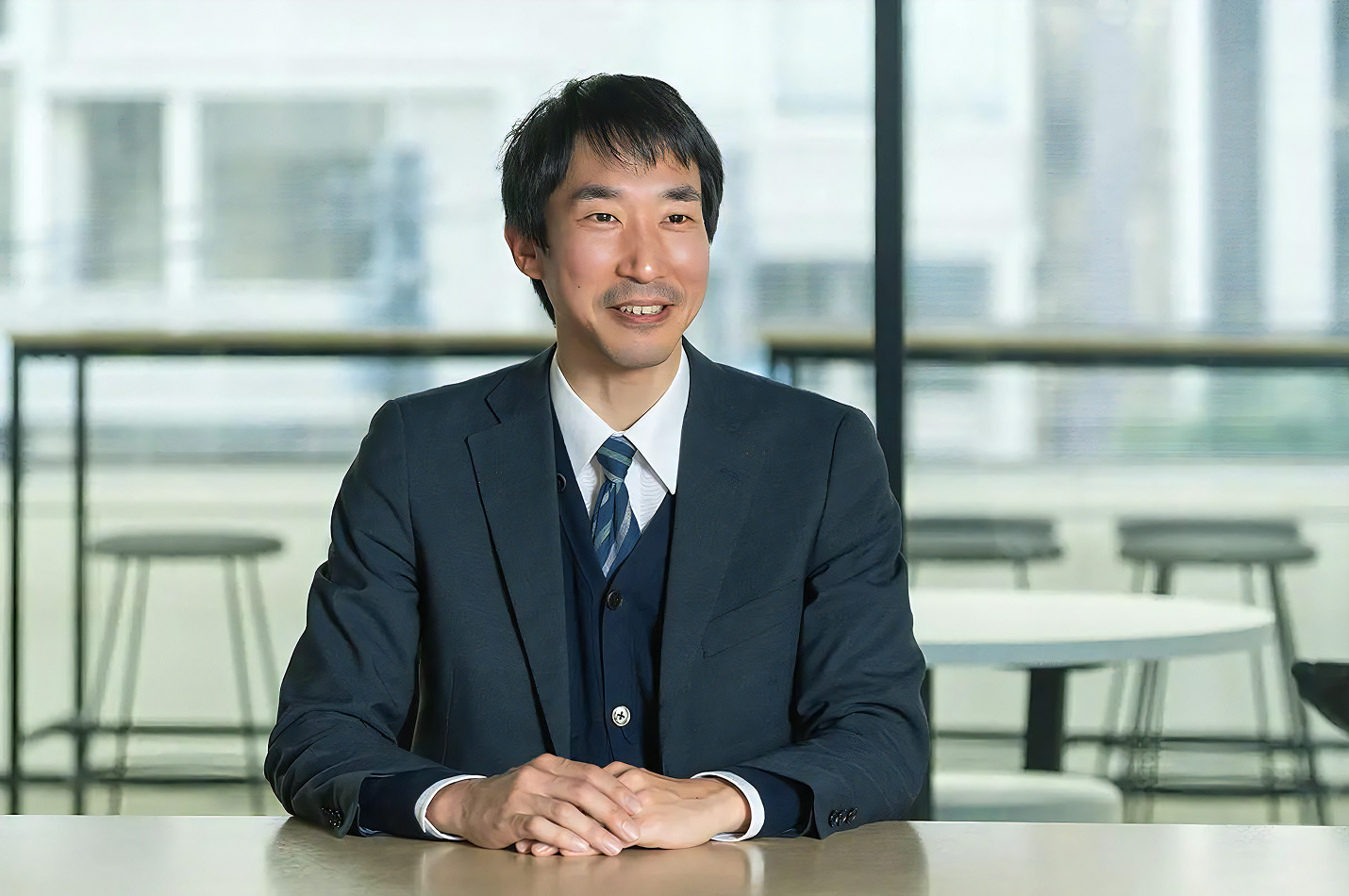
Shohei Okano, Director of the Climate Change Observation and Research Strategy Office at Japan’s Ministry of the Environment.
Japan was the first country to successfully deploy a satellite capable of precisely measuring greenhouse gas concentrations from space—a milestone it achieved as early as 2009. Even today, the satellite continues to deliver high-fidelity data far beyond its expected lifespan, reaffirming the nation’s leadership in space-based environmental monitoring. This unique convergence of precision, reliability, and continuity has produced a dataset of unmatched depth and integrity. It is this uninterrupted stream of long-term data from the GOSAT program that empowers emissions modeling efforts to yield insights that are not only meaningful, but actionable on a global scale.
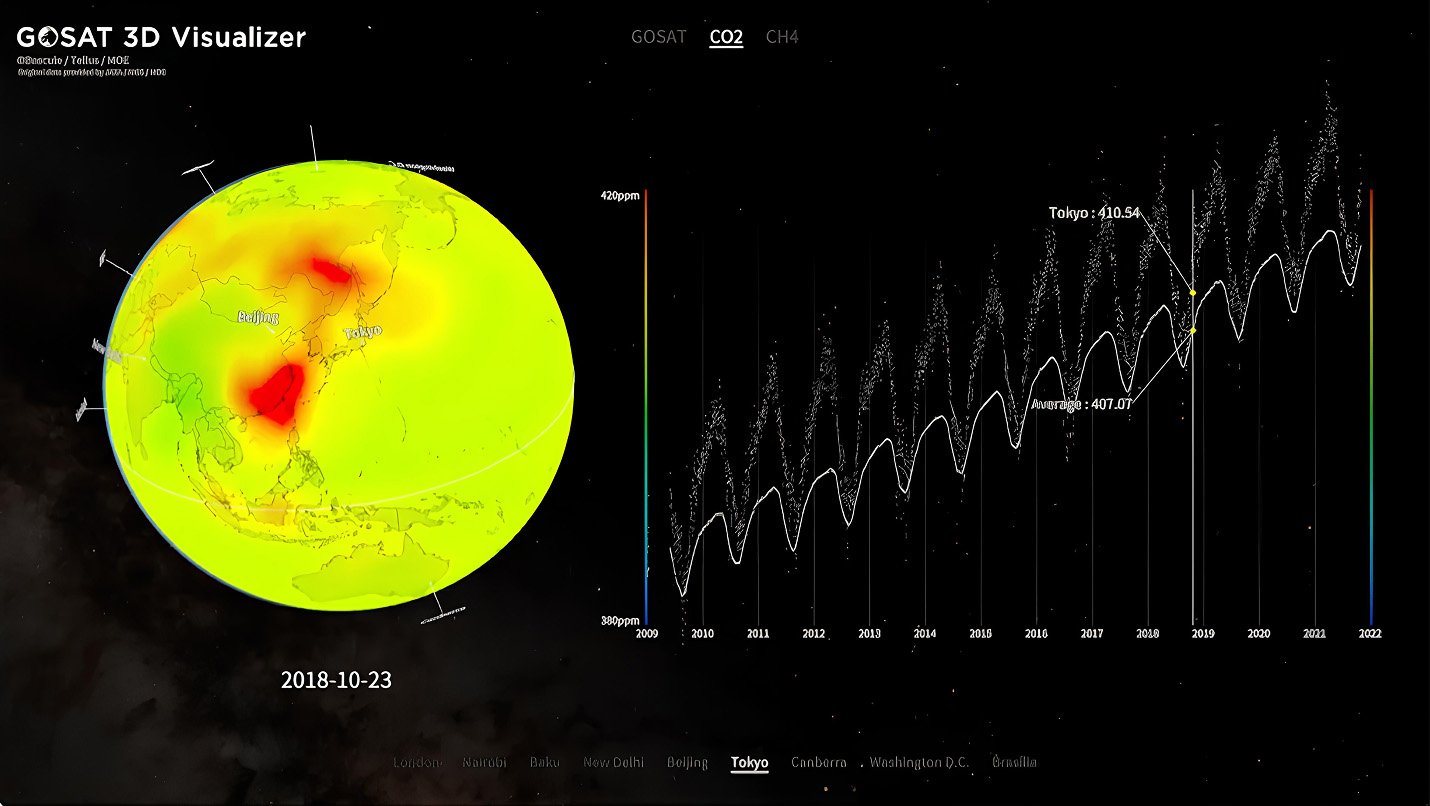
Orbiting Earth at an altitude of approximately 700 km, GOSAT completes a full revolution in just 100 minutes—continuously monitoring greenhouse gas concentrations on a global scale. Today, both the original satellite launched in 2009 and its successor, launched in 2018, remain in active operation.
The visual here shows a 3D representation of CO₂ concentrations near the Earth’s surface (at an altitude of approximately 340 m), along with time-series data for the Tokyo area. The interface was designed by Bascule Inc., a Japanese creative technology company. Leveraging advanced 3D visualization techniques and color-sensitive design—such as gradients of red and yellow—the platform allows viewers to observe how greenhouse gas levels vary across cities, gas types, and time, all while interactively rotating a digital model of the planet.
Okano further notes: “In 2019, for the first time, the Intergovernmental Panel on Climate Change (IPCC) included satellite data in its guidelines for national greenhouse gas inventories, recognizing its value in improving the accuracy of emissions and absorption estimates. GOSAT was specifically cited as a trusted source. Then, in November 2023, Mongolia became the first country to incorporate GOSAT-based emissions estimates and verification into its official submission to the United Nations Framework Convention on Climate Change (UNFCCC), as part of its Second Biennial Update Report. We are now working to expand these satellite-based methodologies globally—starting with support for countries across Central Asia and other emerging regions.”
The Transparency Chain Starts Here, Advancing Boldly Into the Future
Satellite data is fast becoming a vital instrument for enabling informed, global dialogue on sustainability.
Shohei Okano explains: “Satellite observations allow us to demonstrate progress on greenhouse gas reductions with greater objectivity and scientific credibility. When modeled estimates are transparently validated with space-based measurements, efforts toward net-zero can gain real momentum.
“At the beginning of 2025, our team at the Climate Change Observation and Research Strategy Office coined a new tagline to guide our mission: ‘The Transparency Chain Starts from Japan.’ It was inspired by the ideas of our younger members. Today, we see first movers across government, industry, academia, and finance starting to align around this shared goal. Our mission is to set the first link in motion from Japan—building momentum that spreads accountability and transparency worldwide.”
Takumi Hashizume echoes that vision in his message to Forbes JAPAN readers.
“Collaborative efforts to reduce emissions represent one of the most symbolic applications of space technology—because they intersect with every industry and touch nearly every aspect of daily life. But this is just the beginning. As the chain reaction accelerates, space will no longer feel distant or abstract. Instead, we’ll see tangible examples of how it touches our lives and industries directly,” he says.
“Companies like Space One—in building launchpads and developing rockets—are helping to set this chain reaction in motion. At MUFG, we see it as our role to work side by side with partners from both space and non-space sectors—to help build this chain, link by link, and move forward with hope, toward a more transparent and sustainable future.”
Takumi Hashizume
Joined MUFG Bank in 2006 and held roles in corporate banking, including finance solutions for global clients at headquarters and overseas branches. After leading investment development initiatives at the Industry Research & Development Division, he launched the Space Innovation Office within the Sustainable Business Division in 2024. He currently serves as Head of the office and as a Board Director of Satellite Data Service Planning.
Shohei Okano
Joined Japan’s Ministry of the Environment in 2005. His experience includes secondments to the Ministry of Agriculture, international research postings, and work on risk assessments related to contaminated soil, pesticides, and disaster waste. He now leads Earth observation initiatives using the GOSAT series and oversees Japan’s national GHG inventory within the ministry’s Global Environment Bureau.
Yasutaka Fujii
Joined Mitsubishi Electric in 2003 and has since been involved in the development of optical sensors for satellites at the Kamakura Works. He led the development of the TANSO-3 sensor onboard GOSAT-GW, scheduled for launch in FY2025. Since October 2024, he has been developing satellite-data-based solutions at the Space Business Development Center.


MAR. 27, 2025
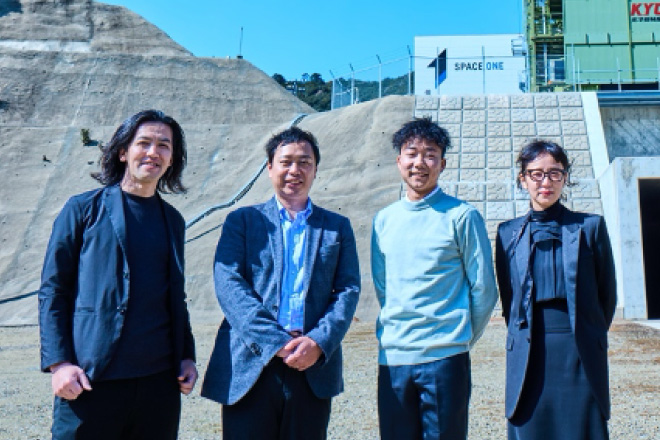
Pioneering a Spacefaring Future: How SPACE ONE and MUFG Sparked Local Innovation in Japan’s Southernmost Town
Yoshimi Nagayama
Space Innovation Office, Sustainable Business Division, MUFG Bank, Ltd.
Yuri Katsuike
Space One Co., Ltd.
Keigo Yoshida
Wakayama Prefectural Government
Kentaro Kiyono
Undergraduate Student, Wakayama University

MAR. 31, 2025
Dream Chaser’s Homecoming: Cross-Industry Collaboration Driving the Future of Oita Spaceport
Yuta Inaba
Space Innovation Office, Sustainable Business Division, MUFG Bank, Ltd.
Tadashi Morimitsu
Oita Prefectural Government
Ryuto Hashiba
Space Program, Japan Airlines’ Business Development Division.